Tag: healing

  • Reclaiming Worthiness: How to Remember You Are Enough

    Reclaiming Worthiness: How to Remember You Are Enough

    There are many ways women come to the question of worthiness.

    Sometimes it arrives quietly, as a dull ache in the background of daily life.
    Sometimes it shows up as exhaustion, or burnout, or a harsh inner voice that never seems satisfied.
    And sometimes it becomes visible only when everything slows down and there’s nowhere left to hide.

    If you’ve ever felt like you need to do more, be better, or prove yourself before you’re allowed to rest, feel at peace, or treat yourself kindly, you’re not imagining things.

    You learned this somewhere.

    And learning something is not the same as choosing it.

    Worthiness Is Often Taught as Conditional

    Many of us grew up in environments where love, safety, or approval felt conditional.

    You may have learned that you were worthy when you were:

    • productive
    • helpful
    • agreeable
    • successful
    • quiet
    • strong

    And that when you struggled, slowed down, or needed care, something about you was suddenly too much or not enough.

    Over time, those experiences can shape a belief that worthiness must be earned.
    That rest is a reward.
    That kindness toward yourself must be justified.

    This belief doesn’t usually announce itself clearly.
    It hides in habits, in self-talk, in the way you push yourself past your limits without even noticing.

    Why “Just Love Yourself” Rarely Helps

    You may have been told to “just love yourself more” or “work on your self-worth.”

    But for many women, those suggestions land as pressure rather than support.

    Because if worthiness feels distant or inaccessible, being told to feel worthy can actually reinforce the belief that you’re failing at yet another thing.

    Reclaiming worthiness is not about forcing a new belief or repeating affirmations you don’t feel connected to.

    It’s about gently remembering what was already there before conditions were attached to it.

    Worthiness Isn’t Something You Build. It’s Something You Remember.

    Here’s the truth that often gets overlooked:

    You don’t need to become worthy.

    You don’t need to improve yourself into worthiness.

    You don’t need to heal everything, resolve everything, or understand everything first.

    Worthiness is not a destination.
    It’s not a personality trait.
    It’s not a reward for good behavior.

    Worthiness is the quiet truth of your existence.

    And while it may feel buried under years of conditioning, stress, and self-criticism, it has never actually left.

    What Remembering Worthiness Can Look Like

    Remembering worthiness doesn’t always feel empowering or dramatic.

    Often, it looks very small.

    It might look like:

    • stopping before you’re completely depleted
    • choosing rest without explaining yourself
    • speaking to yourself with less cruelty than usual
    • allowing a feeling without trying to fix it
    • letting “good enough” be enough

    These moments may not feel like breakthroughs.
    But they are acts of remembering.

    Each time you choose kindness over punishment, you loosen the grip of the belief that you must earn your right to exist as you are.

    When Worthiness Feels Out of Reach

    There may be days when none of this resonates.

    Days when your inner critic is loud.
    Days when self-compassion feels fake.
    Days when worthiness feels like a concept meant for other people.

    On those days, remembering worthiness doesn’t mean forcing yourself to feel better.

    It might simply mean not adding more harm.

    It might mean saying:
    “I’m struggling today, and that doesn’t make me less deserving of care.”

    That, too, is an act of remembering.

    A Gentle Reflection

    If it feels supportive, you might sit with this question — not to answer perfectly, but to notice what arises:

    Where did I learn that I had to earn kindness, rest, or love?

    There is no need to judge the answer.
    No need to resolve it.
    Awareness alone is enough to begin softening what no longer serves you.

    Coming Back to Yourself, Slowly

    Reclaiming worthiness is not a one-time realization.

    It’s a relationship.
    One you return to again and again, especially when old patterns resurface.

    Some days you’ll feel more connected to it.
    Other days you’ll forget.

    Both are part of being human.

    If you’re looking for a gentle place to practice remembering — without pressure or performance — you’re always welcome to join my free community, The Self-Love Scribe Women’s Circle.

    It’s a quiet space for women who are learning to be kinder to themselves in small, doable ways.

    And whether you join or not, I want you to know this:

    You are not behind.
    You are not failing.
    You are not asking for too much.

    You are enough — not because you’ve proven it, but because you’re here.

    One breath.
    One moment.
    One gentle return at a time. 🌿
  • Creating a Self-Love Altar: A Sacred Space for Daily Connection

    Creating a Self-Love Altar: A Sacred Space for Daily Connection

    A self love altar does not need to be elaborate, expensive, or aesthetically perfect to be meaningful.

    At its heart, an altar is simply a space that reminds you to return to yourself.

    In a world that constantly pulls our attention outward, a self love altar becomes a quiet invitation inward. It is a place where you pause, breathe, and remember that you are worthy of care, presence, and tenderness, exactly as you are.

    For many women, especially those who have spent years caring for others or pushing through exhaustion, creating a sacred space for self connection can feel unfamiliar at first. But that unfamiliarity is often a sign that it is needed.

    This is not about doing a ritual correctly. It is about creating a relationship with yourself that feels safe and supportive.


    What a Self Love Altar Really Is

    A self love altar is not about worship. It is about remembrance.

    It is a visual and energetic reminder that you matter. That your inner world deserves attention. That self love is not something you earn after productivity or perfection, but something you practice daily in small, meaningful ways.

    Your altar can hold whatever helps you feel grounded, seen, and connected. It can change over time. It can be messy. It can be simple.

    There is no wrong way to create one.


    Choosing the Location

    Start by choosing a place that feels gentle and accessible.

    This could be a corner of your bedroom, a small shelf, a nightstand, a desk, or even a windowsill. It does not need to be permanent or visible to others. This space is for you.

    Ask yourself where you naturally pause or where you would like to pause more often.

    The most important thing is that it feels safe and inviting, not like another obligation.


    What to Place on Your Altar

    Let your altar reflect you.

    Here are a few ideas to guide you, not rules to follow.

    Oracle or Tarot Cards

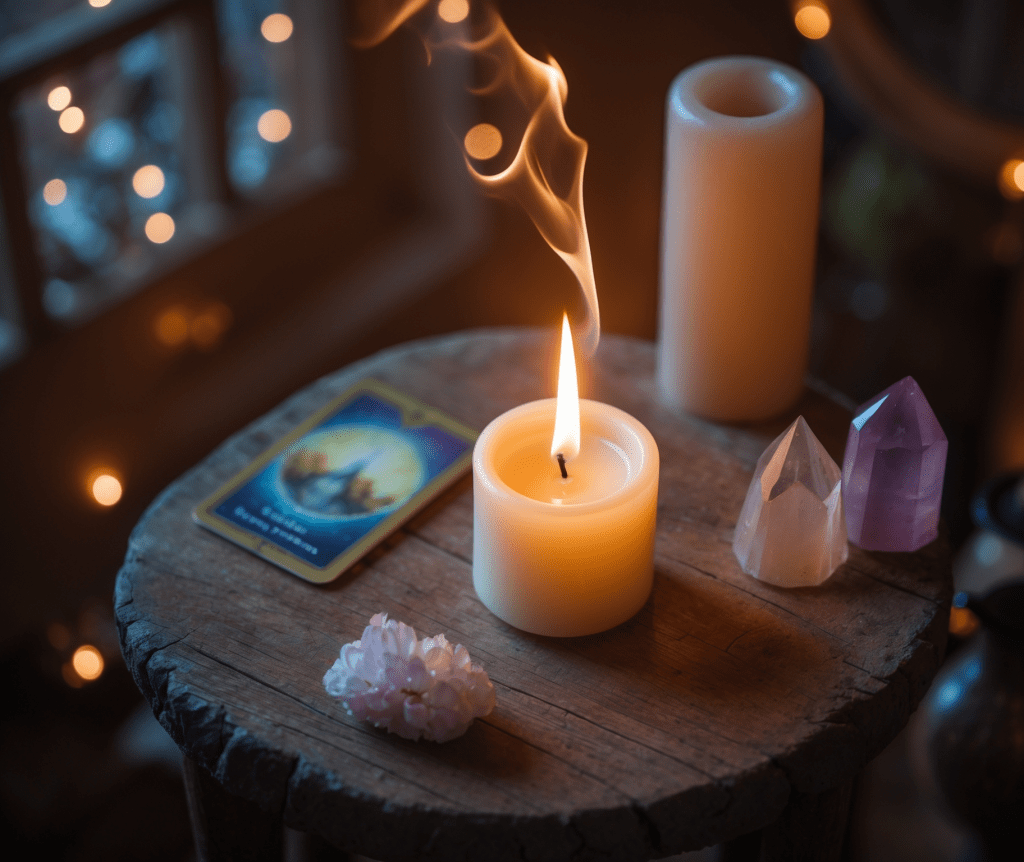
    Many people like to place a card of the day or week on their altar. Choose one that feels supportive or reflective of what you are moving through. Let it be a quiet companion rather than a message you must decode.

    A Candle

    A candle represents presence and intention. Lighting it, even for a moment, can signal to your nervous system that it is safe to slow down.

    Natural Elements

    Crystals, stones, feathers, flowers, or leaves can help ground your energy. Rose quartz or rhodonite are often associated with compassion and emotional healing, but trust what you feel drawn to.

    Personal Objects

    Photos, jewelry, small keepsakes, or written affirmations can anchor your altar in your lived experience. These items can remind you of love, resilience, or parts of yourself you want to honor.

    A Journal or Pen

    Keeping a journal nearby makes it easier to reflect when something arises. This is not about writing pages each day. Sometimes one honest sentence is enough.


    Using Your Altar as a Daily Practice

    Your self love altar does not require long rituals.

    In fact, it works best when it fits naturally into your life.

    You might light a candle and pull an oracle card in the morning. You might pause there in the evening and ask yourself how you showed kindness to yourself that day. You might simply rest your hand on your heart and take a few slow breaths.

    These moments may seem small, but they are powerful. They teach your body and mind that self connection is allowed and available.

    Self love grows through repetition, not intensity.


    When Resistance or Guilt Shows Up

    It is common to feel resistance when creating a self love altar.

    You might think you do not have time. You might feel silly or indulgent. You might wonder if you are doing it right.

    These thoughts are not signs that you should stop. They are often signs that you are touching something tender.

    If guilt arises, gently remind yourself that caring for yourself does not take love away from anyone else. It makes more of it possible.

    Your altar is not another task. It is a place of return.


    Let Your Altar Evolve With You

    Your needs will change, and your altar can change with them.

    Some seasons call for grounding. Others call for softness. Some call for rest. Others for courage.

    Allow your altar to reflect where you are, not where you think you should be.

    This flexibility is part of self love too.


    A Gentle Invitation

    If you would like to begin today, start small.

    Clear a space.
    Choose one object that feels meaningful.
    Take one breath with intention.

    That is enough.

    A self love altar is not about creating something beautiful for others to see. It is about creating a space where you can meet yourself honestly and kindly.

    And that meeting, even for a moment, is sacred.

  • How to Build Self-Trust After Betrayal or Heartbreak

    Relearning how to hear yourself again

    When betrayal or heartbreak crashes through your life, the wound doesn’t just come from what someone else did — it comes from the way it shakes your relationship with yourself. You start to question your intuition.
    Your judgment.
    Your worthiness.
    Your ability to choose people who are safe.

    And perhaps the most painful question of all:
    “How do I ever trust myself again?”

    Self-trust doesn’t return in one big moment. It rebuilds like dawn — slowly, softly, almost imperceptibly at first. But it can return.
    And when it does, it’s stronger, wiser, and more rooted in truth than ever before.

    Let’s walk through this gently, love.
    One breath at a time.


    1. Acknowledge the rupture, not the blame

    When trust breaks, we often turn inward with harshness:

    “I should’ve known.”
    “I ignored the signs.”
    “I was stupid.”
    “I can’t trust myself with anything.”

    But this is your wounded heart speaking, not your wisdom.

    What you can acknowledge is the rupture — the moment when something shifted, when reality no longer aligned with what you believed.

    Naming the rupture without self-blame is the first step toward healing.

    Try saying:
    “Something painful happened, and I’m learning from it. My intuition isn’t broken.”


    2. Remember: heartbreak clouds intuition — it doesn’t erase it

    When we’re in love or deeply attached, our nervous system is wired toward connection, not analysis. You didn’t “miss red flags” because you’re naive. You trusted because you’re human, open-hearted, and hopeful.

    You see clearly after the storm, not during it.

    Your intuition didn’t fail you.
    Your heart simply wanted to believe in love — and that’s nothing to be ashamed of.


    3. Reconnect with your body — your first inner compass

    After betrayal, many people disconnect from their body. You might feel numb, dizzy, foggy, or separate from yourself.

    This is your system protecting you.

    To rebuild self-trust, you must rebuild connection with the body, because:

    ✨ The body knows before the mind does.
    ✨ The body whispers truth before the heart can admit it.
    ✨ The body is your oldest, most loyal guide.

    Try simple practices like:

    • Placing a hand on your chest and breathing slowly
    • Naming sensations (tight, warm, fluttery, still)
    • Sitting with one emotion at a time
    • Asking your body: “What are you trying to tell me?”

    Your body will always answer — softly at first, then clearer over time.


    4. Let yourself grieve the version of you who trusted

    There is grief in losing a relationship, and a different grief in losing who you were within it.

    The part of you that trusted deserves mourning — not judgment.

    She trusted because she believed she was safe.
    She trusted because she loved.
    She trusted because she hoped.

    That part of you is not weak.
    She is sacred.

    Grief allows you to release shame and make room for a wiser, stronger version of trust to emerge.


    5. Start with small acts of self-alignment

    Self-trust is rebuilt through the smallest things — not the big decisions.

    Ask yourself:

    ✨ What do I want to eat?
    ✨ Do I need rest or stimulation?
    ✨ Do I want to say yes, or am I saying yes out of fear?
    ✨ Does this feel good to me, or just familiar?

    Every time you choose what’s true for you, you send a signal inward:

    “I hear you.”
    “I’m showing up for you.”
    “You can trust me.”

    Self-trust grows from these micro-moments of honesty.


    6. Stop overriding your inner no

    One of the deepest wounds after betrayal is realizing all the times you felt a subtle “no” in your body — and ignored it.

    This doesn’t make you foolish.
    It makes you human.

    But moving forward, one of the strongest ways to rebuild trust is to honor your inner no immediately — even when it’s inconvenient, uncomfortable, or disappointing to others.

    Your inner no is sacred. It is your protector, your boundary, your compass.

    And every time you honor it, your system learns:
    “She listens to me now.”


    7. Replace self-blame with self-witnessing

    Instead of:

    “I should have known,”
    try:

    “I understand why I didn’t know at the time.”

    Instead of:

    “I can’t trust myself,”
    try:

    “I’m learning to hear myself again.”

    Self-witnessing is the practice of observing your experience without attacking yourself for it.

    It’s how you turn a wound into wisdom rather than a weapon.


    8. Let your transformation be slow

    Self-trust isn’t rebuilt overnight. It’s more like tending a garden you abandoned during a storm — you pull weeds, water slowly, and let the soil repair itself.

    And then one day, almost without realizing it, you make a decision that feels clear. You choose yourself with certainty. You feel the click of inner alignment.

    That’s the moment you know:

    “I trust myself again.”

    Not perfectly.
    Not in every situation.
    But truly.

    And from that trust, a new life grows.


    You are not broken — you are becoming

    Heartbreak doesn’t destroy your ability to trust.
    It reshapes it.
    Refines it.
    Deepens it.

    The version of you emerging now is wiser, more attuned, more grounded, and more compassionate with herself.

    You deserve to trust your voice, your intuition, and your heart again.

    And you will.

    One soft step at a time. 💗🕯️

  • How to Reconnect With Your Body After Years of Disconnection

    How to Reconnect With Your Body After Years of Disconnection

    For many of us, our relationship with our body has been shaped by years of criticism, comparison, or survival. We’ve been taught to control it, to fix it, to push through its pain or silence its needs. And in doing so, we often learned to disconnect and to live more in our heads than in our skin.

    But your body has never stopped loving you. Even through exhaustion, illness, or neglect, she’s been whispering: “I’m still here. Come home.”

    Reconnection doesn’t happen overnight. It’s not a single moment. It’s a gentle process of remembering that your body isn’t your enemy. It’s your ally. Your compass. Your home.

    Let’s talk about how to begin that journey back to yourself.


    1. Start With Awareness, Not Judgment

    The first step is simply noticing.

    Notice the way you talk about your body – the quiet sigh when you look in the mirror, the inner dialogue that calls you “too much” or “not enough.” This awareness isn’t about shame. It’s about compassion.

    When those thoughts appear, pause and take a breath. Try whispering to yourself, “I see you. I hear you. I’m learning to speak to you differently.”

    That moment of noticing is powerful. It interrupts the autopilot of self-criticism and opens the door to gentleness.


    2. Reconnect Through Sensation

    When you’ve been disconnected for a long time, it’s easy to feel numb. You might not notice your hunger, fatigue, or even physical pleasure.

    Start small in ways that feel safe.

    • Feel the warmth of your morning cup of tea against your hands.
    • Notice the sensation of water on your skin in the shower.
    • Place a hand on your heart and feel the rise and fall of your breath.

    These little acts are how you begin to speak your body’s language again through presence, not pressure.


    3. Move With Kindness

    Movement is one of the most direct ways to rebuild trust with your body but this time, let it be for connection, not control.

    Let go of punishing workouts or rigid routines. Instead, explore how your body wants to move.

    • Sway to your favorite song.
    • Walk slowly and feel your feet on the earth.
    • Stretch like you’re waking up your spirit.

    Ask yourself: What would feel good right now? That question alone begins to shift your relationship from domination to dialogue.


    4. Listen to Your Body’s No

    If you’ve ignored your body’s needs for years, it can take time to hear its “no” again but it’s still there.

    Your body says no through tightness, fatigue, overwhelm, and anxiety. And honoring that no by resting, pausing, or changing course is one of the deepest forms of self-respect.

    You don’t have to earn rest. You don’t have to prove your worth through productivity.

    Your body isn’t here to perform. It’s here to partner with you.


    5. Make Your Body a Sacred Space Again

    You can’t reconnect with something you resent. Begin transforming your body from a battleground into sacred ground.

    This could look like:

    • Placing lotion on your skin as an act of love.
    • Saying “thank you” to the parts of yourself you’ve criticized.
    • Writing a letter of forgiveness to your body for all the times you’ve ignored her voice.

    It’s not about loving every part right away. It’s about remembering that every part deserves love.


    A Gentle Reflection

    Reconnecting with your body after years of disconnection takes courage. There will be moments of grief for the time you spent at war with yourself. But there will also be moments of peace when you realize you can hold yourself with tenderness, exactly as you are.

    Your body may carry pain, illness, or exhaustion. She may feel fragile, unpredictable, or yes, even broken at times. But she is yours. And she is still sacred.

    Loving your body doesn’t mean pretending she’s whole. It means cherishing her through the cracks. It means saying, “Even when you ache, even when you falter, I will not abandon you.”

    She doesn’t need to be fixed to be loved. She only needs your presence.


    Journal Prompts to Go Deeper:

    1. When was the last time I truly felt safe in my body?
    2. What sensations help me feel grounded and present?
    3. What’s one way I can honor my body today, even in a small way?
  • Cards of Compassion: Using Oracle Cards to Grow Self-Love

    When most people think of oracle cards, they imagine a mystical deck that tells the future, a tool of prediction and fate.
    But what if we approached oracle cards differently?
    What if, instead of asking what will happen, we asked what do I need to understand about myself right now?

    That’s where the magic truly begins.

    Oracle cards, when used for self-love, become a mirror reflecting the parts of us that crave compassion, healing, and truth. They invite us to slow down, listen inward, and reconnect with our own wisdom.

    This post gathers the essence of what we explored in the recent Cards of Compassion Workshop, and expands it into something you can return to again and again — a quiet, loving guide for your own self-love practice.


    Why Oracle Cards for Self-Love?

    Tarot and oracle cards both offer insight, but they do so in different ways.
    Tarot has structure of 78 cards, four suits, and a system of archetypes that tell a story. Oracle cards are open, intuitive, and limitless. Each deck carries its creator’s vision and voice.

    That openness makes oracle cards a deeply personal self-reflection tool. They don’t dictate; they invite.
    You can use them to:

    • Reflect on where you are in your relationship with yourself
    • Receive affirmation and encouragement
    • Strengthen your intuition
    • Cultivate a daily rhythm of gentle attention

    Instead of asking your cards to predict something, think of them as companions that mirror your inner landscape. The message you draw is not from outside of you. It’s your own higher wisdom speaking through the imagery and energy of the card.

    Whether you believe that wisdom comes from your soul, your intuition, or something divine, the point remains the same: the answers are within you.


    How Oracle Cards Help You Reconnect with Yourself

    1. Reflection

    Each card is a mirror. It helps you see what’s already stirring beneath the surface like emotions, beliefs, or desires you may not have fully named yet.
    Sometimes, the card simply confirms what you already know deep down but haven’t yet given yourself permission to admit.

    2. Affirmation

    Oracle decks often carry a nurturing, supportive energy. Many include affirmations or gentle mantras that can shift your inner dialogue from criticism to compassion.
    For example, my Sacred Wild deck includes the Polar Bear – Silent Strength card. Its affirmation reads:
    “I honor my solitude and emerge with power.”
    You can repeat it throughout the day whenever you need a reminder that quiet moments are not weakness, they are renewal.

    3. Intuition

    Every time you draw a card, you strengthen your relationship with your intuition. You begin to notice how guidance feels in your body. It’s calm, grounded, and clear, rather than anxious or forced.
    This is essential for self-love because intuition is the voice of your authentic self. When you trust it, you trust yourself.

    4. Daily Practice

    Small, consistent practices are what change the way we relate to ourselves. A five-minute card pull can become a sacred pause. It’s a moment each day to check in, breathe, and listen inward.
    Self-love isn’t built in grand gestures. It’s built in these quiet moments of returning to yourself.


    A Gentle Grounding to Begin

    Before you pull a card, take a moment to breathe.
    Place your hand over your heart.
    Inhale for four counts, hold for four, and exhale for four.
    Let your breath settle your energy.

    As you hold your deck (or imagine holding it), whisper:
    “Show me what my heart needs to remember about love today.”

    Then draw your card.
    Notice the first feeling or image that comes to you before your mind tries to interpret it. That first whisper is often the truth you most need to hear.


    Make It a Gentle Rhythm

    Building a self-love practice doesn’t require hours. It only asks for presence. Here’s how to make oracle cards part of your natural rhythm.

    Card of the Day

    Pull a single card in the morning to set the tone for your day, or in the evening to close it with intention.

    • Ask: “What energy will best support me today?”
    • Keep your card nearby — on your desk, altar, or as your phone background.
    • Return to it when you need grounding.

    Sometimes, one sentence from a card can shift the direction of your whole day.

    Journal Pairing

    After pulling your card, spend 5–10 minutes writing freely.
    Try prompts like:

    • “What part of me feels seen by this card?”
    • “What is this card asking me to remember?”
    • “If this card could speak, what would it tell me right now?”

    Let your thoughts flow. Don’t worry about being poetic or perfect. Journaling isn’t about performance. It’s about connection. The page becomes a place where you meet yourself honestly.

    Self-Love Altar

    Create a small space in your home that feels sacred, even if it’s just a corner of a shelf.
    Add your card of the day, a candle, a flower, or something meaningful like a crystal or photograph. (For crystals, I suggest rose quartz or rhodonite.)
    This is your visual reminder that you are worthy of gentleness.

    If you can, light the candle for a minute or two each day and whisper your affirmation aloud. Over time, this becomes an anchor, a way to return to calm and self-acceptance whenever you need it.

    Evening Pause

    At night, take a moment to reflect.
    Ask yourself:

    • “How did I practice kindness with myself today?”
    • “Where can I offer myself more grace tomorrow?”

    Acknowledge even the smallest acts, like taking a break when you needed one, saying no, or speaking kindly to yourself. Those small acts are what self-love looks like in real life.

    Weekly Weave

    Once a week, review your cards and notes.

    • What themes keep repeating?
    • What messages felt the most powerful?
    • What lesson seems to be unfolding?

    This helps you see your growth over time, something we rarely notice in the moment.


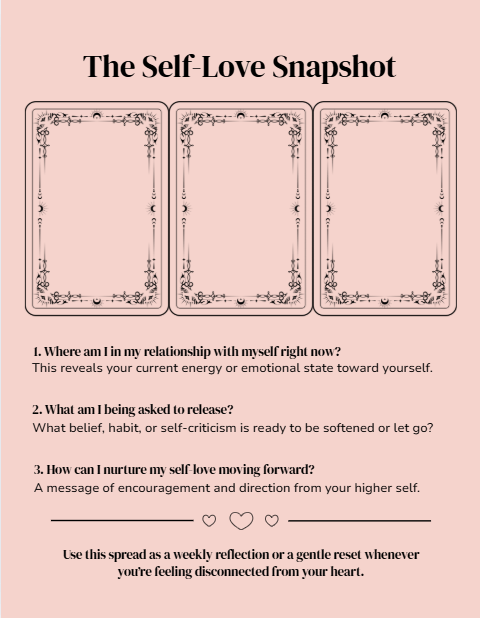
    A Self-Love Spread to Try

    Here’s a simple 3-card layout you can return to whenever you need clarity:

    1. Where am I in my relationship with myself right now?
    2. What belief or habit am I being asked to release?
    3. How can I nurture self-love moving forward?

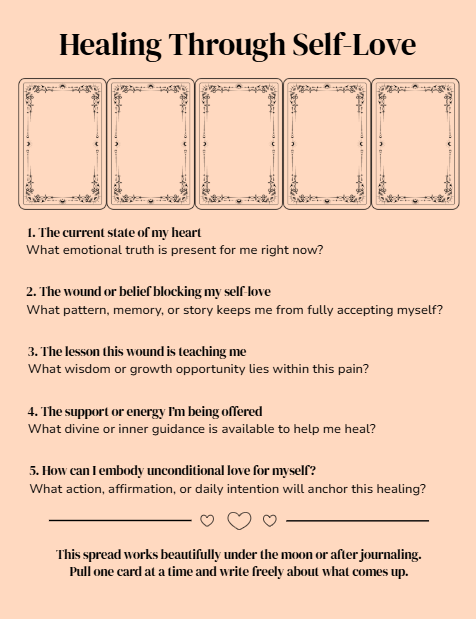
    If you want to go deeper, try a 5-card “Healing Through Self-Love” spread that explores the wounds beneath your self-criticism and how to soften them with compassion.

    (You can find a printable version of both spreads in the Kindness Library inside the Self-Love Scribe community.)


    When Doubt or Comparison Creeps In

    Everyone who works with self-love eventually meets the voice of doubt, the inner critic that whispers, “You’re not doing enough” or “Who are you to teach this?”
    Even I still hear it sometimes.

    During the workshop, I drew the Wolf representing Instinct, Loyalty, and Leadership.
    It reminded me that leading doesn’t have to mean perfection. It can mean standing quietly in truth, guiding from authenticity, and trusting the instincts that got me here.

    If your card today mirrors a similar truth, one that challenges you to trust yourself, lean into it. That discomfort is where transformation begins.


    Creating a Self-Love Practice That Lasts

    If you take one thing away from this, let it be this:
    Self-love isn’t a destination. It’s a relationship and one that deepens with daily attention.

    You can begin small:

    • Pull one card a day.
    • Write one kind sentence to yourself.
    • Light one candle in your name.
    • Take one deep breath before you speak harshly to yourself.

    These are not small things. These are sacred things.

    Over time, these little moments build trust, and trust is the foundation of self-love. You begin to realize that you can rely on yourself to show up, to listen, and to love.


    Begin Today

    Find a quiet moment. Shuffle your cards. If you don’t have a deck, I have a shuffler for my deck the Sacred Wild on my website you can use.
    Ask, “Show me what my heart needs to remember about love today.”
    Let your intuition guide you. Write down what arises.

    This is your message from you, for you.
    Keep it close. Whisper it to yourself whenever you forget who you are.


    Ready to Go Deeper?

    If this resonates with you, you’re welcome in my Skool community, The Self-Love Scribe Women’s Circle.
    It’s a calm, nurturing space for women practicing the gentle art of being kind to themselves. Inside, you’ll find:
    💜 The Kindness Library with free resources, printables, and oracle tools
    💌 Weekly reflections and prompts
    🕯️ Biweekly group circles for connection and support

    Membership is $7/month with a 7-day free trial, and it includes access to all our resources and journaling guides.

    Your self-love journey begins with one small act of devotion.
    Pull your card. Take a breath.
    And remember: You are already enough. 💗